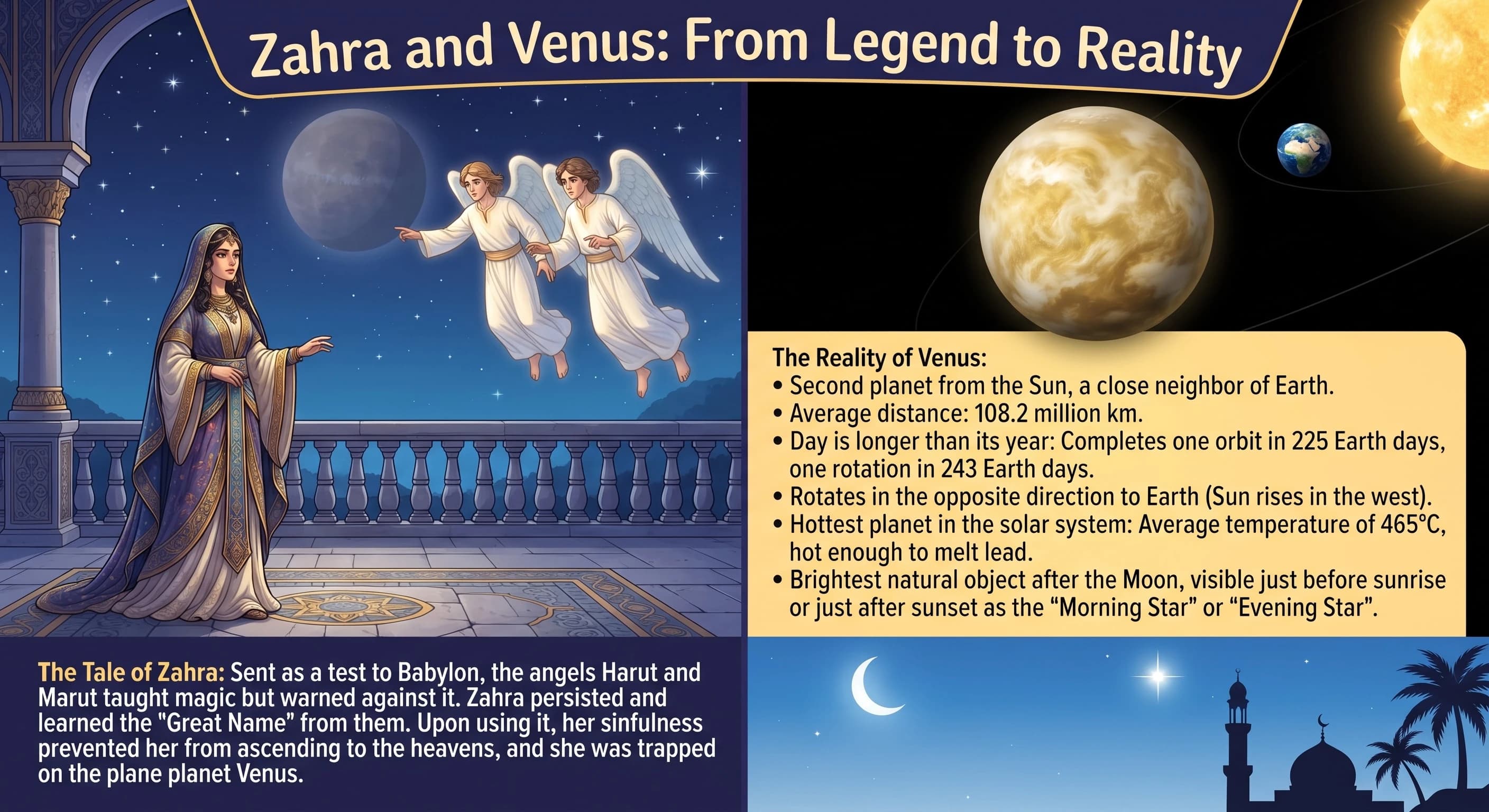

Harut and Marut were two angels sent from the heavens to test people on earth. They appeared in the city of Babylon as young men and taught the locals magic. Whenever someone came to learn magic, they warned, “Learning magic is forbidden; it will take you away from faith.” Those whose hearts shone with faith would stop out of fear, but some unlucky people still learned magic and lost their faith.
One day a woman named Zahra came to them. Harut and Marut tried to persuade her not to learn magic, but she refused, so they taught her anyway.
Because they were angels, Harut and Marut knew the Great Name, a divine word that could lift them to the heavens whenever they wished. By mistake they revealed this secret to Zahra. She coaxed them and learned the Great Name herself. As soon as she pronounced it, she could not rise to the sky, for she was a sinful human. Instead she was taken to the planet Venus, where she became trapped. She remains there to this day.
But children, Zahra’s story is only a made‑up tale. In reality, Venus is the second planet of our solar system and a close neighbor of Earth.
Venus is about 108.2 million kilometres away from the Sun on average. It completes one orbit around the Sun in about 225 Earth days, while it takes about 243 Earth days to spin once on its own axis. You can see that Venus needs more time to turn on its axis than to go around the Sun. In other words, its day is longer than its year.
Unlike Earth, Venus rotates in the opposite direction. Because of this, the Sun appears to rise in the west and set in the east when seen from Venus.
Venus is the hottest planet in the solar system. Its average surface temperature is about 465 °C, hot enough to melt lead. This extreme heat is caused by a very thick carbon‑dioxide atmosphere that creates a strong greenhouse effect, trapping heat and preventing it from escaping into space.
Venus is the brightest natural object in the sky after the Moon. Its dense clouds reflect a large portion of sunlight, making it shine brightly. Since Venus never strays far from the Sun in the sky, we usually see it just before sunrise or just after sunset. That is why people call it the “morning star” or the “evening star.” It is not a real star, but a planet in our solar system.
Tomorrow morning, when you go out for the Fajr prayer, look up at the sky and be sure to spot the planet Venus.