
Written by: Syed Mazhar Mushtaq
Faizu had returned to his old neighborhood after about fifteen years. Many of his father’s friends still lived there. His grandfather’s name was Hayat Muhammad Khan, but he was known in the area as "Hayatu the Donkey-man," so people knew Faizu as "Hayatu’s grandson" and "Aasu the laborer’s" son. Passing through various streets of Lea Market, he stood in front of his ancestral home, where his younger uncle’s family lived. Three donkeys were tied in front of the house, and two donkey carts were parked there. These donkeys and carts were their means of livelihood, and they hadn't gone to work that day either.
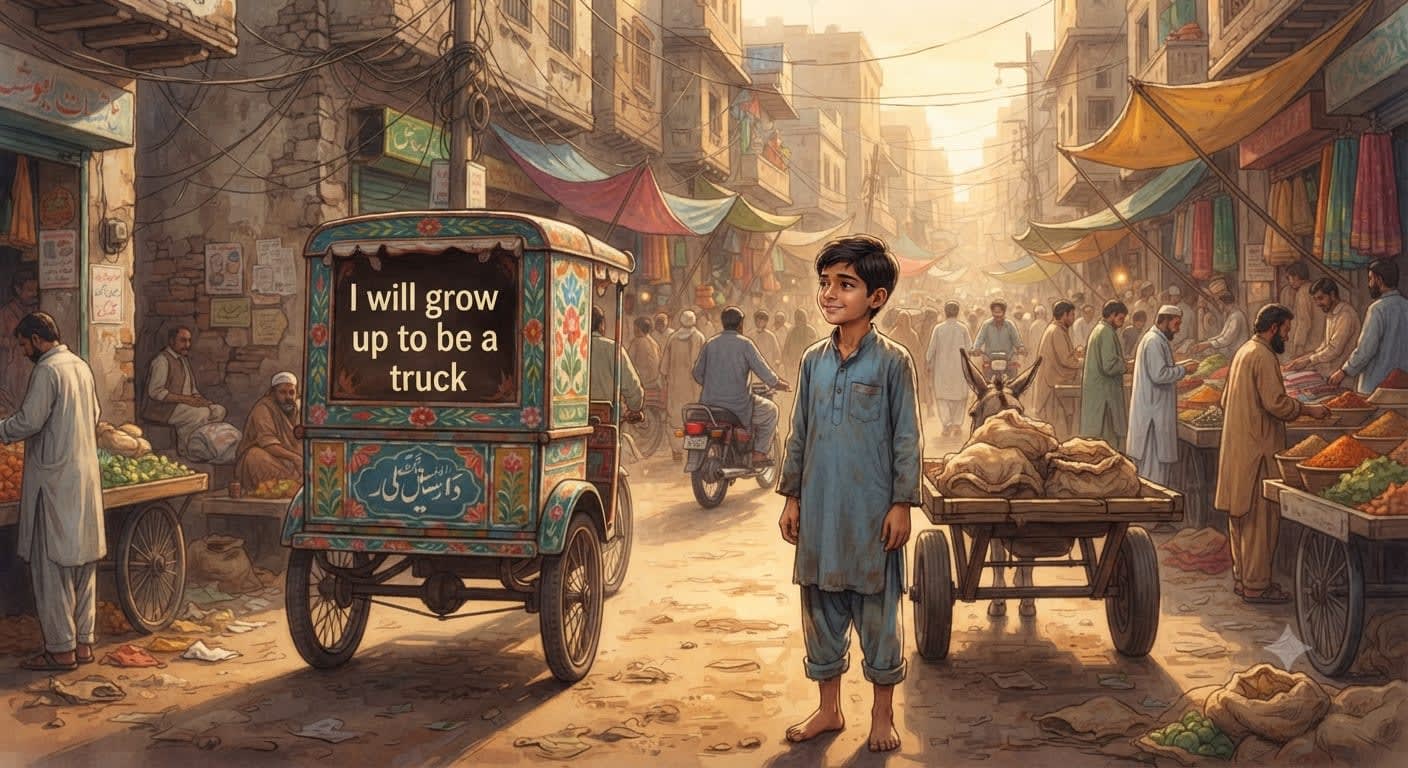
Faizu remembered everything. He would eat quickly after coming home from school, and then his mother would hand him a small tiffin, which he would take to the tonga stand near the grass merchants' shops. It wasn't very far from his house, but it still took him twenty to twenty-five minutes to get there. Even if his father wasn't there, he would sit in a corner under a shop’s awning. His father would transport goods from the warehouses of Jodia Bazaar, Jhuna Market, and Lea Market to various shops on his donkey cart. However, upon getting some free time in the afternoon, he would come to the tonga stand, where all the donkey-cart drivers would eat together. Some rickshaws were also parked there; perhaps their drivers lived nearby. One sentence written on a rickshaw always intrigued Faizu. Finally, one day, he asked his father, "Abba! It is written on this rickshaw: 'I will grow up to be a truck.' How many days will it take for it to become a truck?" Aasu laughed loudly upon hearing this and said to the other laborers joining in the meal, "Did you hear what your nephew is asking? He wants to know when the rickshaw will become a truck." Everyone looked at Faizu and laughed, teasing him.
Time passed. Faizu was now in the ninth grade. As usual, after coming from school, he would go to his father. Previously, he only brought food, but now he began to help his father. He would say, "Abba, leave it, I will lift this sack." Aasu would smile and say, "No, no. Your back is still weak. Just give me a little support; I will lift the sack. Your father is very strong, and my father was a wrestler—a real wrestler! He used to lift two sacks at once. Your grandfather had a big name in the market."
One of Faizu’s good habits was that he never missed school, and he especially loved Sir Umar’s class. Sir Umar was such a teacher; he treated students like his own children and explained lessons very well. One day, while teaching the event of Migration (Hijrat), he said, "One form of migration is that if, despite hard work and best efforts, one cannot make a living in a certain area, they should go to another place and try their luck. Perhaps Allah has placed their sustenance there. Similarly, it is not necessary that future generations should keep doing the same work their fathers and grandfathers have been doing. If there is no growth in that work, or if the income is low and one cannot make ends meet properly, there is no harm in adopting another profession or business; in fact, one must do so. We call this change 'Economic Migration'."
Faizu came home thinking deeply. He ate his meal, and when his mother placed his tiffin in front of him, he said in a tearful voice, "Mother, how long will we keep loading and unloading sacks on the donkey cart?" His mother looked at him in surprise. She was about to say something when Faizu said, "Look, Mother! There is no shame in hard work, but the era of the donkey cart has passed. The wages are low. And the way the Seths and passersby scold Abba for no reason—I cannot bear to see it. I have made a decision."
"Son, what decision...?" his mother asked.
He sat on the cot near his mother. "Look, Mother! Everyone praises your cooking. You make rice for me every day; I will sell it outside in the street."
"But son...!!" The words remained in her throat. Faizu said impatiently, "Mother, don't refuse. What is the harm in experimenting? We aren't starting from giant cauldrons; one or two pots are enough."
On the way home that evening, following his mother’s advice, Faizu brought five kilos of rice and some spices on credit from a known Seth. He informed his father about the decision at night. He didn't say anything, but by nodding his head, he gave his support to the decision.
The next day, when he came from school, the pot of rice was ready. He made a counter by placing bricks under a broken table, then neatly arranged the pot of rice and a few plates on it. He placed a cooler filled with cold water on one side. Faizu’s house was in a street where people passing to and from various markets walked by. Soon, customers started coming. His younger brother and sister would run to hand a plate of rice to a customer or give someone a glass of water. There were no tables or chairs, so everyone had to eat standing up.
In the evening, when they calculated, they were short by seventy rupees. Faizu felt ashamed because it was his idea. He was trying to find some justification. His mother understood his state. She stepped forward, put her hand on his head, and said, "Don't lose courage, son. I think you didn't realize how much rice to put in the plates. No worries, tomorrow everything will be fine." And the next day, the loss actually turned into profit. Hearing about a profit of three hundred rupees in one day made everyone happy.
In the days that followed, the business didn't just walk; it started running. The two months of school holidays also came as a blessing for Faizu. It hadn't even been two full months since he started selling rice, and the business had grown from a small pot to a large cauldron.
One day, they found out that a shop was available for rent nearby, at a great location. They had a meeting at home at night, and in the morning, Aasu sold his donkey and cart to arrange the advance payment. Thus, the rice stall that used to be set up outside the house shifted into a shop. From morning until afternoon, Aasu would manage the shop, and then his son would take over. Allah helped them so much that in the next four or five years, they built their own catering house, from which cooked cauldrons of rice were delivered to their five branches established in different parts of the city. They also started receiving wedding orders, and those who sold rice on carts in the streets also started coming to them to fill their pots.
As their hands opened up to wealth, they changed their house too. They moved from the gateway of Lea Market to a good house in Garden East. They also bought a good car for commuting.
He stood in front of the ancestral house for a long time and would have stood longer, but a voice startled him: "Faiz Muhammad Sahab! The food is ready, everyone is waiting for you." He walked along with that person.
Aasu congratulated his friend on his son’s wedding and also put a thick envelope in his pocket. His friends still drove donkey carts, but he made sure to attend their joys and sorrows.
On the way back, Aasu smiled at Faizu, who was sitting in the driver's seat, and said, "Do you remember that question of yours...?"
"Which question...?"
"The one about when the rickshaw will grow up to become a truck?"
Faizu laughed loudly, "Yes, Abba! I remember."
"So, you found the answer, right...?"
Faizu slowed the car's speed and asked, "Abba! What is the answer to that?"
"The same one Sir Umar told you. A rickshaw can only grow up to become a truck when its thinking is big. When it wants to be big. Instead of spending their life driving a rickshaw, a person wants to be the owner of a truck. Instead of being a blind follower of old paths, they think of new ideas and then dedicate themselves to the cause. Just like you did." Aasu spoke the last sentence in a way that sounded like he was thanking his son.
"And Abba, did you notice one more thing?"
Aasu looked at him with questioning eyes.
"Abba! Today, no one was calling you 'Aasu the laborer' and me 'Faizu.' Everyone was calling us Asad Muhammad Khan and Faiz Muhammad Khan. Perhaps money changes names too."