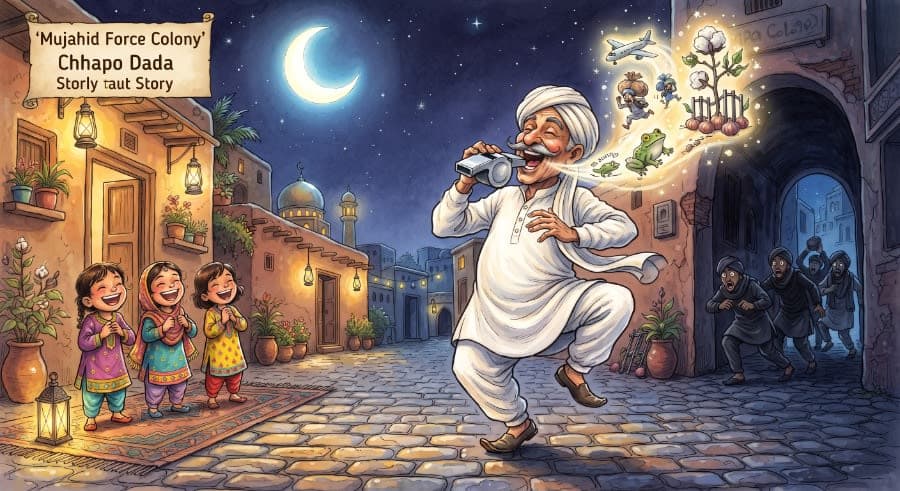
There was a small settlement consisting of a few houses, which the residents called "Mujahid Force Colony." All the settlers lived together and had even formed a regular organization for the colony, headed by Chhapo Dada.
Chhapo Dada was not a grandfather with grandchildren, but rather a bullying grandfather. He was very bad-mannered, outspoken, and stubborn, yet full of foolishness. Whenever any danger arose, the colonists always pushed him to the front. Because of this, Chhapo Dada was the talk of the town in every corner of the colony.
One night, some thieves came to the colony and stole a lot of valuables, and no one even caught a hint of it.
The next morning, when all the colonists found out that the thieves had cleaned out the place overnight, they all ran frantically to Chhapo Dada’s shop. Unfortunately, Chhapo Dada was not present at the shop at that time. Not finding him there, they all rushed toward his house.
Chhapo Dada was busy exercising in his courtyard that morning. When Chhru heard the loud noise of so many people, he thought they had come because of his rebellious acts and were going to kill him. So, he made a run for the roof, climbing the stairs as fast as he could. The colonists followed him onto the roof, shouting slogans of, "Grandpa, listen... Grandpa, listen!" Seeing the whole scene from the edge of the roof and finding no other way to escape, Chhru jumped off and fell down. But right where he landed, there was an open drain of dirty water flowing, and Chhru fell straight into it.
Not long after, the colonists reached the drain and spread around it. When Chhru Grandpa fearfully pulled his head out of the drain, he was surprised to see everyone laughing at him (he thought he had fallen into a nice swimming pool).
"Chhapo Dada... go home, take a bath, and come to the shop..." said one of the men. And all of them turned back.
Chhru left for home in that exact condition. His pure white vest and shalwar had turned completely black from falling into the drain, and his appearance—which already looked beastly all day long—had now become terrifying because of the foul odor.
Some children were playing cricket in the street. When they caught sight of Chhru Grandpa, frightened, they ran towards their houses screaming, "A ghost, a ghost!" Well, Chhru didn't care about that at all; he kept walking toward his house with the same grandeur.
"Hey, hey, hey... where did this fat creature come from? Hey, is there anyone in the neighborhood who can get rid of this black ghost? He barged right into my house... Wait, just wait here... I'll call your father right away. He'll chop you into pieces and feed you to the stray dogs. You must have heard his name; his name is Chhapo Dada."
"It's me, hide (Chhru) Grandpa..."
When Chhru entered the house, his wife, who was cooking, said while waving her tongs. In response, Chhru revealed his identity.
"Oh... are you wandering around looking like a stained sinner? You were exercising in the courtyard, then how did all this happen...?" she asked in surprise. Chhru narrated the whole incident to her, and only then did she heave a sigh of relief.
Chhru took a bath, went to his shop, and soon many people gathered around him. The night's incident was discussed, and someone was requested to act as a night watchman. Because of such a dangerous "incident," no one was ready to do night guard duty (perhaps knowing that no payment would be given). This heavy burden was once again taken upon his own head by Chhapo Dada, and he agreed to do the guard duty.
The night silence was spread all around, and the moon was shining brightly in all its glory. Just as the moon was awake, Chhru Grandpa was also awake. Chhru was whistling continuously, singing his favorite songs, and doing an African dance from here to there, when suddenly a few thieves approached from one direction. They saw Chhru dancing like this.
One of them said: "It looks like he swallowed a frog for breakfast... and now the frog is jumping around in his stomach, which is why he has no peace and is hopping around like a frog."
Suddenly, Chhru Grandpa caught sight of these thieves. Both sides were horrified; both parties realized that the watchman and the thieves had now come face to face and something was bound to happen. But using his political wit, Chhru not only avoided a physical brawl ("dhanga mishti") but said to them: "If you want to take everything, you must accept a few conditions of mine." The thieves agreed to listen to the conditions. Chhru stated his condition as follows:
"We will both tell each other a story. You must agree to the story as we tell it. Remember, the agreement must only be in 'yes'. If it's from your side and you agree, I will believe you; if it's not from my side, I will do whatever you say." The thieves accepted this condition.
The leader of the thieves began to tell his story, which went like this:
"My father was a bank manager. His monthly salary was three rupees. Every month my father would bring those three rupees, and we would go shopping in the village. From there, we would bring a month's worth of rations, meat, vegetables, food items, bags full of children's toys, school supplies—in short, every worldly good—and still, one rupee and twenty-five paisas would be left over. We would take the goods home and give the remaining money away as charity." Throughout the story, Chhru kept nodding and saying yes. When the story ended, the thieves were terrified and asked Chhru to tell his story. Chhru told his story like this:
"Once, my father and I went to the city of Delhi in Sri Lanka... Then from Whaley, we booked an airplane. That airplane dropped us off in the beautiful village of Washington in Delhi. From there, my father bought mustard seeds. Then we sowed those seeds. A month later, those seeds grew into plants. Iron bars came out of these plants. Onion flowers grew on top of the iron bars. Closed cabbage flowers emerged from those flowers. Then, when we started to pick them, they turned into cotton flowers, and we harvested the cotton. Then we gave that cotton to an old woman; she took some money from us and made plastic yarn out of that cotton. Then we went to the tailor, the tailor made clothes for us, and then we came back to our beloved country, Pakistan. But at the ship's railway station, someone stole our clothes."
The thieves kept saying yes to everything. But when Chhru uttered these words, they were utterly trapped. Those words were:
"Now, the clothes that were stolen from the station are right on your bodies."
At these words, the thieves would have been trapped whether they said yes or no. But they took the opportunity to run away from there, and right before Chhru's eyes, they vanished. Chhru let out a triumphant laugh... and blowing a loud whistle, he shouted:
"Keep awake..."