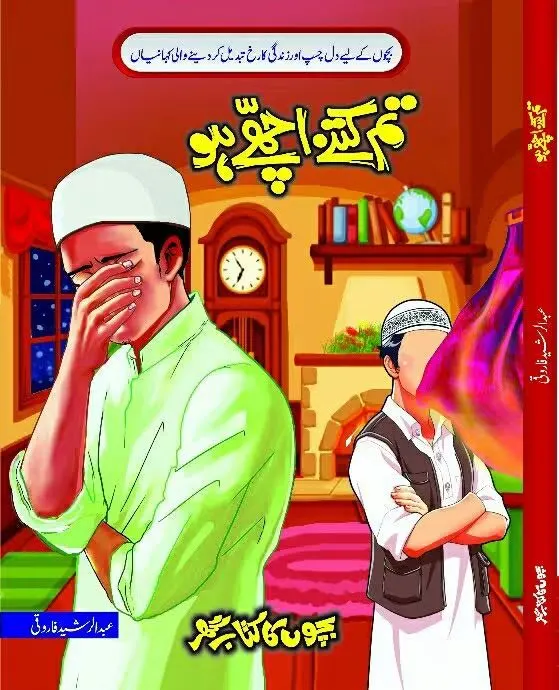
Abdul Rashid Farooqi’s name is familiar to children who read early‑stage Islamic books. He has been writing for this magazine for years, and I learned a while ago that he comes from Jhang, the hometown of the great children’s‑literature pioneer, Ishtiaq Ahmed. Jhang has produced many writers who love children and help shape good character.
Since the beginning, the Children’s Book House has never lowered its standards. Every book is carefully chosen for both its outer quality and its inner message, and only material that teaches and uplifts young minds is offered.
The book under review contains seventeen beautiful, lesson‑filled stories. Reading them not only sparks a love of books in children, but also sharpens their moral habits. The first story, “Abu,” is not the collection’s opening tale but a very important one.
In it a child asks his father for many precious and expensive things. The father’s earnings from his job are not enough to grant all the wishes. Speaking with great kindness, the father tells his son, “Son, if I were to fulfill all these wishes, I would have to take a dishonest or forbidden path. Would you want your father to achieve your dreams by doing something wrong?” Hearing this, the child’s conscience awakens, and he immediately gives up his demanding wishes. The story shows that when parents teach right from wrong from an early age, they can turn even the impossible into possible. A person’s greatest duty is to raise his children with strong moral and spiritual values.
The second story, “The Hunt,” is a gripping, suspenseful tale told from two different angles. A young man comes to his uncle with the intention of killing him. The uncle, using his quick thinking, patience, and understanding, not only saves his own life but also guides the misguided youth onto the right path and cools his anger. The story’s other side shows that the uncle does more than simply forgive; he also makes sure the nephew faces the legal punishment for his serious crime. In this way the nephew learns the importance of law and justice and vows to avoid such foolish and criminal ways for the rest of his life, becoming a responsible citizen.
The third story in the collection moves ten years forward and follows a child who, as a youngster, was torn from his real parents by a cruel robbery. After a decade, he meets a destitute man living in a ramshackle hut who bears the same name he had as a child. When his true parents try to bring him back, the boy flatly refuses to return. The tale gently and emotionally describes the hidden bonds of love and how a human heart can adapt to harsh circumstances.
Another powerful piece in the book is a plan written about the freedom of the Kashmir valley and the lives of its people. Just as brave young heroes in traditional, freedom‑loving stories join forces to devise daring schemes and ultimately achieve victory, this story shows truth triumphing over oppression. The tyrannical army suffers heavy loss of life and property. The writing awakens in children the spirit to stand up against falsehood and to support the oppressed.
While reading the story about the coloured paper, I was reminded of an old tale of the mischievous Mircho, who would toss small stones along the road to find his way back home. In the same way, the characters Imran and Junaid begin scattering pieces of coloured paper on their path during their journey. Thanks to this clever trick, they safely reach home without suffering any serious harm.
The cover story of *How Good You Are* is one of the most moving and spiritual writings in the collection. In it, a young person, in his youthful ignorance, strays onto sinful and wrong paths. When the pure teachings of the Prophet Muhammad (peace be upon him) and Islam illuminate his heart, he sincerely repents, leaves the swamp of sin, and returns to a clean, sincere, and truthful life. Stories like this erase hopelessness from children’s minds and play a vital role in guiding them back to forgiveness, repentance, and the reality of life.
*Eid Mission* is a sweet, traditional tale written for the joyous occasion of Eid. The children of the house cleverly and lovingly receive a double Eid gift from their grandfather. Instead of spending the money on their own toys and games, they give it to the needy and poor in society. By doing so, they also teach the adults a beautiful lesson: even when grown‑ups are busy and overlook the poor, the little ones’ compassion and attention reach those who truly need help.
Another moral story bowed its head, using the symbolic world of dreams with great skill. The main character, Waqas, had committed many small and big sins in his life. Inside his dream, all those misdeeds appeared before him as strange, frightening shapes. When he woke up, he discovered that even his uncle knew about his hidden wrongdoings. That shame filled him with a deep sense of guilt, and the feeling pushed him to abandon his sins and turn to sincere repentance.
The next tale is a tear‑jerking story about the suffering and helplessness of innocent people in occupied Kashmir. The way Baaji Kulsoom tells it is so painful and heartfelt that it brings tears to the eyes.
A sweet and instructive story from the animal kingdom follows, about a little bird. It teaches readers that feeling, love, and compassion are not limited to humans and their relationships; nature has also given animals and birds a great capacity for empathy, kindness, and mercy toward one another.
The next story presents a helpful remedy for a girl named Shazia after she returns home from school. Shazia feels upset because the other children keep their distance and do not become close friends with her. Her wise and gentle mother gives her a simple formula: if she treats others with good manners, love, and gentleness, they will respond with the same kindness. When Shazia follows her mother’s advice, the remedy works wonderfully; she makes many friends and everyone becomes her companion.
“Gift” is another very sweet and moving story in this collection. A father promises his son a special present if he completes all the fasts of Ramadan. When the boy finishes his fasts, instead of asking for the gift, he asks to help an orphan child. In doing so, he gives a wilted orphan flower a chance to bloom again and shows that the Prophet Muhammad ﷺ instructed us to care for orphans—he fulfills that duty through his father’s promise.
One more folk‑tale‑like piece tells the greatest wisdom of people living in mountainous, hard‑to‑reach areas. When travelers face severe difficulty because of obstacles on the road, a few brave, good‑hearted people remember a saying of the Prophet ﷺ: removing a painful obstruction from the path is also an act of charity and reward. Together they clear the road, making travel easier for nearby villages and earning great blessings for themselves.
Just as a small bag of cricket balls can spin a whole lesson around it, the story shows how a simple game can teach big values. While playing cricket in the lane, the ball rolls into the yard of a strict neighbor. Getting the ball back becomes a huge problem and a real challenge for the children. Yet that uncomfortable incident turns into a positive change. In the effort to retrieve the ball, the youngsters begin a journey toward learning and reading. Their curiosity spreads, and Aunt Kheyran’s daughter, inspired by the experience, decides to study and learn to read and write.
The next tale is about a talkative, careless boy who loved to chatter pointlessly. His older brother Shahid kept warning him not to speak without need and to understand the value of silence, but the boy would not listen. Finally, Uncle Farooq gently explained the wisdom of speaking only when necessary and showed how the boy’s needless talk had already caused a serious loss in his private life. After that lesson settled in his mind, he realized that idle words only bring harm. He corrected his bad habit and chose a better path.
Another thoughtful story in the book warns about a great sin: gossip, backbiting, and speaking ill of others. Two girls become tangled in a swamp of idle talk, constantly searching for each other’s faults. This becomes their everyday habit. When they finally recognize the seriousness of their mistake, they are overwhelmed with fear and remorse, wondering whether Allah will forgive such a huge wrongdoing. Their sincere repentance and deep awareness of their sin become the most important first step toward fixing their lives.
The final beautiful story is about friendship. It explains, in clear language, the essential principles of a true and honest bond. Through this tale, children learn that when a sacred friendship is formed, the friends must always remember to support each other in every good deed, to stop one another from wrongdoing, and to keep jealousy or misunderstanding from ever entering their pure relationship.
Children’s books that teach good manners and faith are the backbone of any healthy society. A child’s mind is like a clean sheet of paper; the lessons written on it shape a person’s whole life. Abdul Rashid Farooqi’s book is a steady guide for youngsters, teaching kindness, humanity, self‑sacrifice, repentance and Islamic values. Today, social media and low‑quality content rush into children’s fragile minds, but writers like Abdul Rashid Farooqi are a true blessing. Stories like his pull children away from make‑believe traps and lead them toward a realistic life, respect for parents, a sense of community and gratitude to God. Positive tales water pure thoughts in a child’s heart and awaken a love for good and a dislike for wrong. Children’s literature is a quiet builder of a new generation’s character, and when young readers are given such high‑quality, engaging, and instructive books early on, they grow into thoughtful, wise people who help create a balanced, peaceful, and moral society.