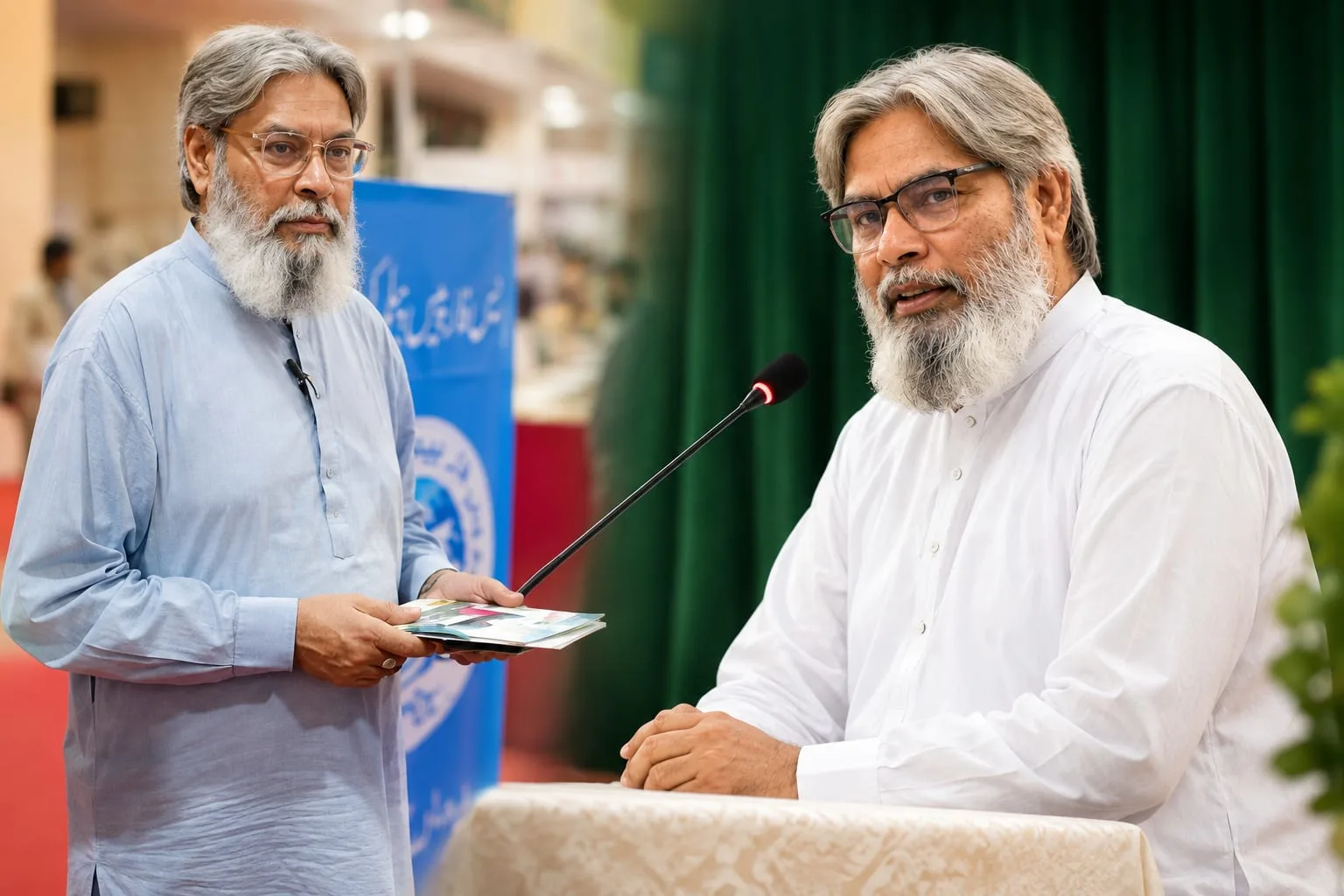
Interview panel: Danial Hassan Chughtai · Tabinda Tariq Aks
In the world of letters, a few names carry a light that helps raise whole generations. Kawish Siddiqui is one of those towering figures of Urdu literature, with a creative discipline that stretches across decades. He began his literary journey in Karachi, the City of Lights, and when he later settled among the warm-hearted people of Lahore, his writing found new range and new depth. Since 1980, there is hardly a respected magazine or digest in Pakistan that has not carried the mark of his graceful pen.
The clearest proof of his creative gift is the Sarmad series — a landmark work that brought thousands of young minds back to books. The characters he created, Rafiq Langra, Sheeda Talli and Mai Jeenan, still shine bright in readers' memories. From children's stories full of innocence and moral warmth to spellbinding adult novels like Aanch and Khwab Gazeeda, every word he has written feels like a gift from above — one that has turned countless people into lifelong readers. As Nau Umar Digest makes its historic return, we sat down with this remarkable writer to open a few of the less-explored corners of his literary and intellectual life.
Assalamu Alaikum wa Rahmatullahi wa Barakatuhu. How are you, sir? First of all, thank you for taking time out of your busy schedule to speak with Kahani Ghar.
When, how and where did you write your first story? Where did the idea come from, and what made you write it?
As luck would have it, my very first story turned out to be a long one. It ran in three parts in the newspaper Jasarat, under the title Sharfu ki Kahani (Sharfu's Story). The character of Sharfu came to me from watching a friend of mine. I still remember its two main characters — Sharfu and his friend Arshad Golimarvi. The places in that story are the very places where we used to roam around.
Your literary journey stretches over four decades, from 1980 to today. What is the basic difference you see between readers' tastes then and now?
The real change is in how much readers read and know. A writer can no longer satisfy a reader with flights of fancy, wordplay and illogical situations. Education, observation and the internet have exposed a great deal. Today a writer has to deal with reality and illusion at the same time. To me, that's a good sign — people question what you write, and they do it without hesitation.
The literary air of Karachi and the cultural life of Lahore — how did these two cities shape your personality and your creativity?
For me, both were fascinating in terms of how people behave within their cultures. I watch, I understand, I learn. I have seen and felt rivers, mountains and deserts, which is why you'll find people rooted in the soil in my writing. In the interior of Sindh and Punjab, people are simple and loving. There's no quarrel over language — relationships are built on how you understand them and how you respond. And whatever becomes part of your feelings will always find a way into your writing; somewhere, somehow, it seeps through and spills over.
When you wrote your very first word, did you imagine this journey would go on so long and so brilliantly?
No one knows the end of the road at the beginning, and you can't map out every stage of the journey yourself — time decides that. What is certain is that whatever talent you have must be lasting. A passing hobby won't stay with you until the end. Writing is an ongoing matter of awareness, ability, learning and understanding.
There's hardly a digest or magazine in Pakistan that hasn't published your work. What is the secret behind such a steady and popular creative journey?
One thing I learned: whatever you do, do it with complete loyalty and sincerity. I never wrote for free. I wrote on an editor's request. I wrote after understanding my surroundings and the reader's state of mind. I wrote romance with delight and high aesthetic values — but I always stayed away from using romance to stir up lust or cheap thrills. There isn't a single story or novel of mine that every member of a family can't read. That's why the self-censor inside me kept doors open for me everywhere. Editors know who writes what. Even back then, my stories went straight to the calligraphers for typesetting. And most importantly, you must be punctual. Delivering your manuscript on time is your responsibility.
In your early days, which teachers or literary figures influenced your writing style the most?
Every piece of writing needs to be read in its social and political setting. Before Partition, then the stages of Partition, then the building and rebuilding of a new state — the pain and suffering people endured, and the readers and writers who lived through it, were very different from today. Their work should be understood in that context. People today live in a global world with very different problems, and writing should be seen through that lens too. For me, I was moved by every piece of writing in which I found myself and my own feelings. Not by any one writer.
How hard or easy was it to write for the digest world and live up to readers' expectations?
The more connected you are to life, the more powerful your feelings become. Then your experiences, observations, reading, your skill with words, and the harmony between setting and character — when the reader feels the touch of all this in your writing, they say, "This is exactly what I wanted." In other words, readers want something they can digest. That's when you become a successful digest writer.
There was a time when digests were an essential part of literature. How do you see their survival in today's digital age?
The golden age of digests can come back even today. The condition is an editor and a writer who truly understand a story. Without proper pay, you'll only get a weak story. You will never get a strong, tightly woven story that pulls the reader in.
After moving to Lahore, did your themes and style change noticeably?
Every writer is affected by a change of place and society. What I saw, understood and felt across Pakistan made my stories richer in feeling. Then, abroad — Germany, Denmark, Spain, Thailand, the Arab countries — all of it widened my canvas. And I managed to connect with and understand people simply as human beings.
What was the moment you realized your pen had become a responsibility toward society?
A writer is answerable only to his own conscience. How can reforming society be his responsibility? Schools and colleges take responsibility for teaching. They don't promise to get you through exams or find you a job. So how can a writer's pen carry the burden of society? A writer is the voice of society's conscience. Answering that voice is the people's responsibility. So, to me, this idea makes no sense. It's like when a young man goes astray and people say, "Get him married, he'll straighten out." If his parents' advice and his teacher's discipline couldn't fix him, how is an eighteen- or twenty-year-old girl supposed to — a girl who lives under the constant threat of kicks, beatings and the sword of divorce?
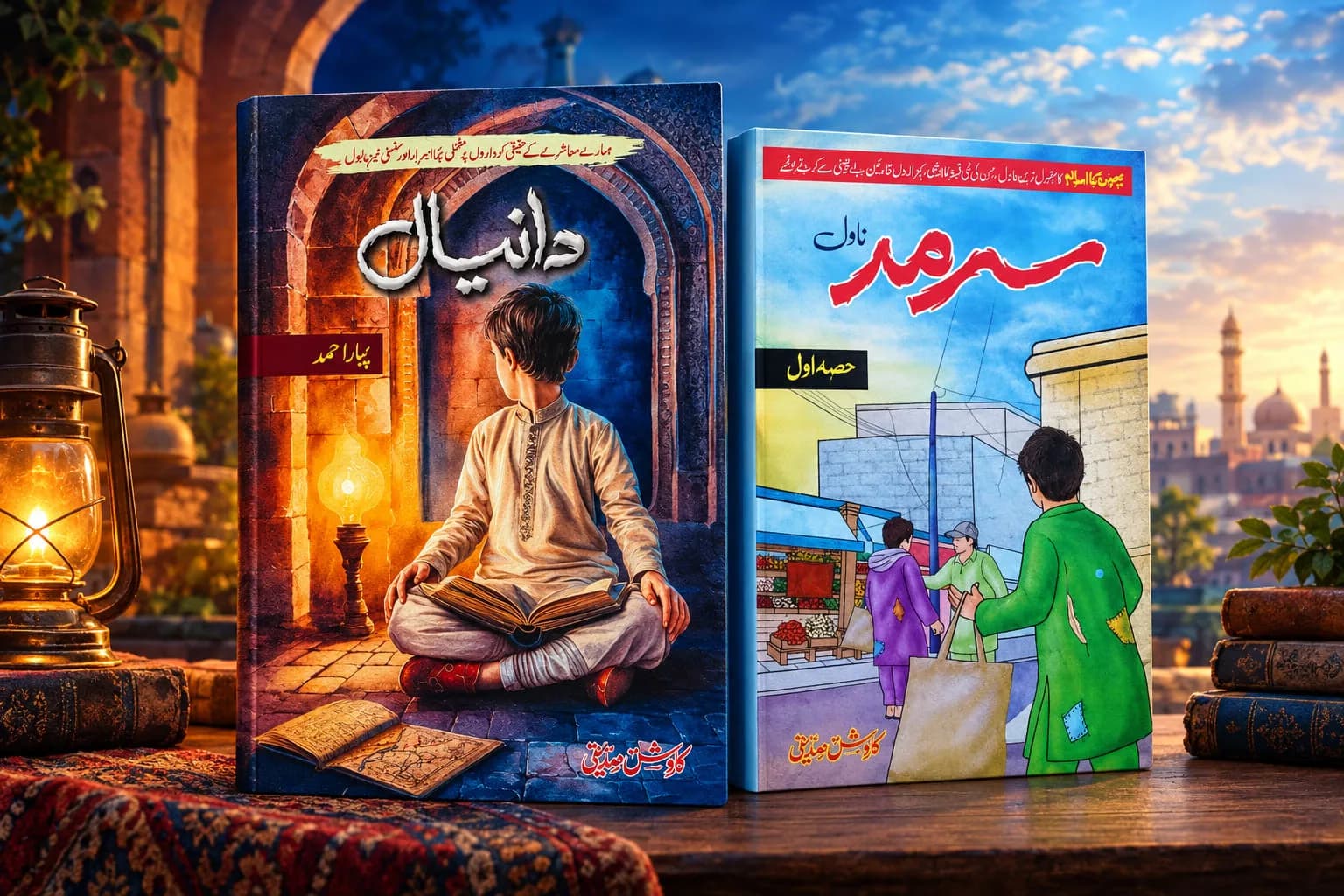
The Sarmad series brought you enormous popularity. How did the idea for this masterpiece first come to you?
I have seen life up close, and I have seen reality in all its raw, painful nakedness. Almost every other person asked me about Sarmad: "Is it true? Is it your autobiography? Are you Sarmad?" When a reader can't tell story from reality, that story starts to feel like everyone's — like the whole society's own tale. Let me tell you, Sarmad doesn't hold even ten percent of the real facts. People simply couldn't bear it. And since it was written for teenagers, I was careful while writing it as well. Sarmad is the story of our entire society.
From serialization in Bachon ka Islam to a six-volume book, how memorable was Sarmad's journey?
At first, I didn't even know Bachon ka Islam. Muhammad Faheem Alam introduced me to its editor, Faisal Shahzad. He came to my home with Faisal Shahzad. We talked and chatted, but Sarmad never came up at the time.
Later, Faheem Alam asked whether I had anything written for children. By then I had written only a few pages of Sarmad, and I sent those to him. After that he just kept saying, "Write more… write more." Then he sent the pages to Faisal Shahzad, who liked them too — and the love readers gave it after that became history. But Bachon ka Islam had a policy: because of limited pages, it couldn't run a serial for more than a year. On top of that, its historic 1,000-page special issue was coming, and no installment could run in it. Sarmad was on such a large canvas that it simply couldn't be wrapped up so quickly. So it had to end with a note saying that, due to policy constraints, Sarmad was being concluded, and readers who wanted to continue could read it once it came out as a book.
You know that publishing an already serialized novel as a book is a big risk. But Faheem Alam decided to publish it. Around 2000, I think, two volumes came out, and then two more every year. Honestly, it was the readers — the children and their parents — who got it written out of me, asking again and again, "More Sarmad… more Sarmad."
Characters like Rafiq Langra, Sheeda Talli and Mai Jeenan became so popular that they got novels of their own. How did you shape them?
This too is a first in Urdu literature, for adults and children alike — that the side characters of a novel set such records that their books were snapped up as soon as they came out. I believe thousands have sold by now. Each of these characters demanded a novel of its own. They're all people from around us. I write about a character only as much as the character asks for. Adding or cutting isn't in my hands. That's why a character stays with you — because the rest of the character, it completes within you, if you can feel it.
Were these characters drawn from real life, or were they flights of imagination? Are they real people?
All of these characters live in this very world — among us, within us. Cruelty, violence, anger, hatred; orphans and the destitute; gamblers, addicts, clerics, idle spectators; those who eat up their sister's share of inheritance; those who perform Hajj and Umrah every year and still create shortages of flour, ghee and oil — that's us, isn't it? Haven't you met them? So how can they be fake, fictional or made up? Every character pulls me in and makes you feel its presence. That's who Sarmad, Rafiq Langra, Sheeda Talli and Mai Jeenan are.
Since 2021 you've been writing about individual characters from the Sarmad series. What divine blessing would you call children's long-lasting interest in it?
Everyone feels. Everyone speaks. But a writer's words carry a call, a thirst, that touches others and strikes the strings of the heart. That's the basic difference between a writer and a reader. Nature kneads this ability into a writer from the very first day. A writer lives among things, behaviors, people and changing values, understands their structure, and then expresses it through his creative awareness. I write while living among people, woven into their lives. That's why this journey goes on. Several young readers have handed me lists saying, "Now you have to write novels on these characters." So tell me — how could my pen ever stop? It's nothing but a gift from God.
Through the Sarmad series, you have drawn thousands of children toward reading. How satisfied do you feel with this great service?
All I can do is write. I can't force anyone to buy my novels, nor make them read. I give the credit to the parents of my young readers, who freely let their children pick up my books. To the teachers at madrasas, to school teachers and principals who buy the books, read them and give me feedback. They are the ones actually building the reading habit. I'm just a medium, a tool.
Was Sarmad's character a conscious effort to help raise children well?
I'm deeply grateful to God that He accepted my writing, and that not only children but adults too gave it such a warm welcome. Sarmad is that narrative of life you usually look at and ignore — but for me, these are things to think about and understand. At shrines and dargahs, at railway stations and bus stands, people getting off, rushing, saying goodbye, eyes full of tears, faces full of smiles — they're all asking for your attention. Hands held out, begging bowls clinking, malangs draped in beads, beggar women nursing babies, children tugging at your clothes for alms — they're all Sarmad's characters. That's why Sarmad is loved: everyone finds some character from their own life in it.
Sometimes a single masterpiece overshadows all of a writer's earlier work. Has Sarmad's popularity pushed your other work into the background?
That does happen — one representative work becomes your introduction, and I think it also introduces you as a brand. Along with its side characters, Sarmad pushed the sales of my other novels to new heights. My readers became interested in my other books. And honestly, it has now become a community. Yesterday's young boys and girls are now reading Jal Pari and Aanch.
How different, and how difficult, is writing for children compared to writing for adults?
For me it's not a problem at all, because I live among both children and adults; I'm not separate from them. Many of my stories came simply from watching children. In the same way, certain characters moved me, and that's how I wrote Urti Chiriya.
How delicate is it to balance curiosity and morality in children's literature?
If you understand the sanctity of a word and its impact, balance comes into your writing on its own. That's what self-censorship is. All my stories are ones a father and daughter, or a mother and son, can sit and read together.
What was the basic purpose behind launching Nau Umar Digest, and why did you feel the need to restart it now?
Here we have either children's magazines or adult magazines and digests. Between childhood and youth, there's nothing for the teenage years. Nau Umar has come to fill exactly that gap, and that's what it's known for. Second, we don't have a single story magazine, and we want to fill that gap too.
Today's teenagers are lost in mobile phones and social media. How big a challenge is it to bring this generation back to paper books and digests?
Change in every era is the law of nature. Between today's children and those of the past, social media, new school and college curricula and a massive flood of information have changed how minds work. We're bringing all of this to them in the form of stories.
What subtleties must be kept in mind when writing for teenagers? What will be new and different for today's teenagers in Nau Umar Digest? And do you feel that young adult literature has always been ignored here?
There's no doubt at all that young adult literature doesn't count for anything here. There are children's stories and adult digests — so where is young adult literature? The interesting part is that most of our writers today who think they're writing for children are actually writing young adult fiction. Most of our writers don't keep the age group in mind when they write.
Will Nau Umar Digest also be a strong platform for new and emerging writers?
Absolutely. We welcome every good writer. Write — because writing is the expression of your awareness.
Do you plan to offer the digest in a digital format or as an e-book?
For now, we'll give priority to print, but work on that is underway.
What role should parents and teachers play in drawing today's young people toward reading?
Those who don't read themselves, who never talk about books — what kind of encouragement can they give, whether they're teachers or parents? Schools should have proper libraries and dedicated reading periods. Newspapers should bring back their children's pages. TV channels should run book review programs. Books should be promoted as prizes. If we hold a proper reading week, then we can truly encourage reading.
What spirit and thinking lay behind Sunnah story books like Masjid, Dadi Jaan and Angoor ke Daane?
Countless Sunnah stories have been written, and, God willing, many more will be. I wrote Sunnah stories against the backdrop of our own society, because my beloved Sarkar Ji ﷺ came to reform and purify society. So every blessed Sunnah of his is connected to society. That's why these books are different from ordinary Sunnah stories, and they keep being reprinted.
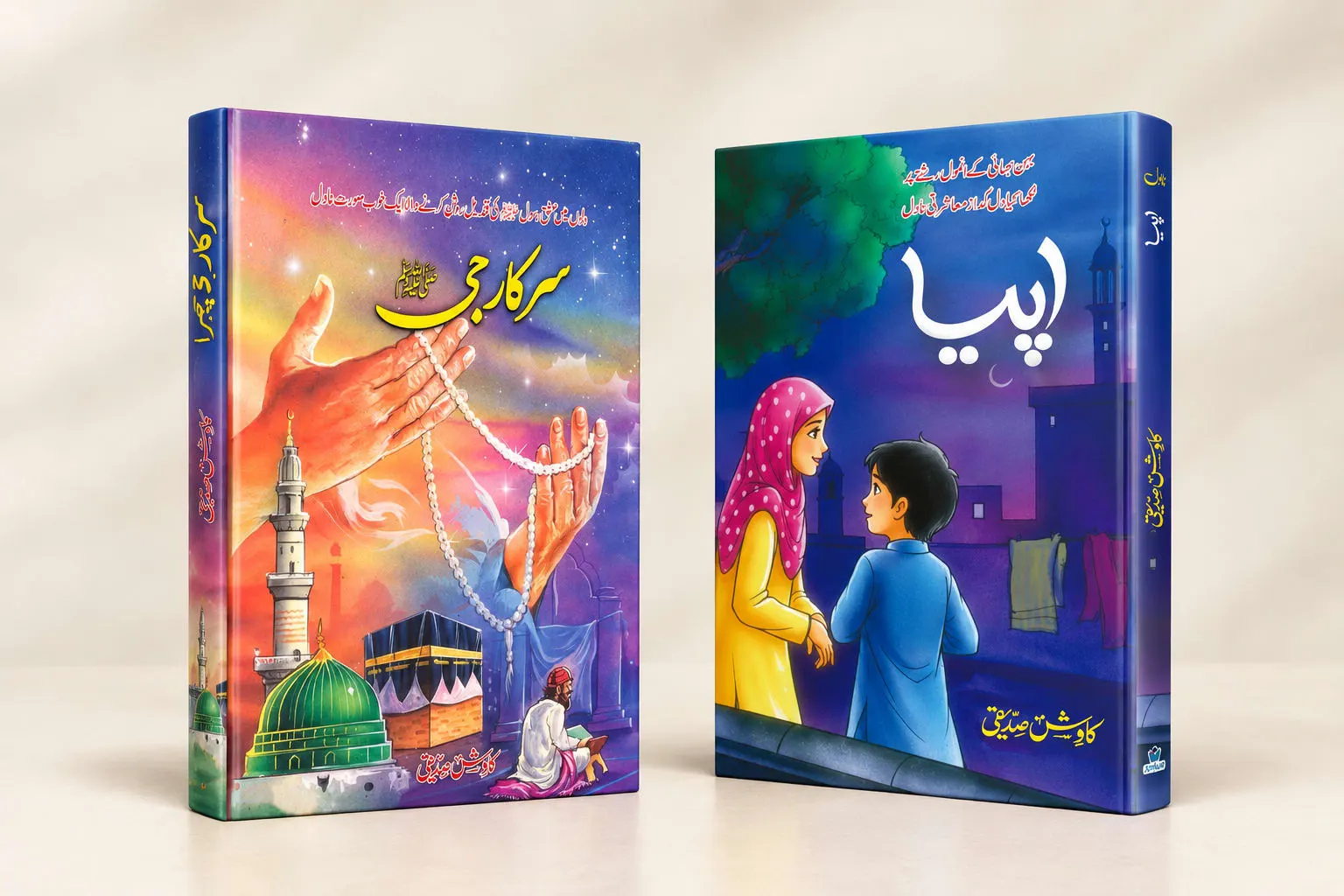
What was going on in your heart and mind while writing such spiritual and emotional titles as Sarkar Ji ﷺ and Allah Ji!?
The same thing you feel while reading them. Allah and His Messenger ﷺ are not only to be believed in, but to be felt — deep inside. I thank my Lord, the Most Generous, for giving me the ability to write these novels. Many people have told me that after reading them, they finally felt close to their faith. Many parents make a point of reading them to their children. People often tell me they read a little every day and pray for me every day. The real foundation of Sarkar Ji was a story of mine, Sarkar Ji, Aap Khush Hain? ("Sarkar Ji, Are You Pleased?"), published in Bachon ka Islam. It was loved immensely, and many people even started reading it at Milad gatherings. The novel came after that. Allah Ji! was written at Faheem Alam's request; it's a novel about child labor. Sarkar Ji, likewise, is based on the Seerah.
In books like Tumhari Ammi! and Apiya, how did you shape the sanctity and love of relationships?
Our relationships basically revolve around mother, sister, father and brother — and the mother and sister are at the center. In the society we live in, respect for women needs to grow, and that respect and sanctity has to be built in children from the very beginning. Have you ever noticed that ninety-nine percent of curses are aimed at women? That our stage dramas are full of jokes about mothers, sisters-in-law, mothers-in-law and wives? The mother-in-law is always cunning and scheming; the daughter-in-law is always plotting to separate the son from his family. The rude behavior toward women in offices — what is all this? It's because we only consider the daughters and mothers of our own homes worthy of respect. Let me tell you, in my house no one is allowed to use the word "cousin." If someone is your maternal uncle's daughter, say, "She's my maternal cousin-sister," or brother. Likewise, "aunty" is a nonsense word. She is your mumani, your khala jaan, your phuphi jaan. Words like "cousin" and "aunty" are thieves — they've broken into our relationships.
What special flavor of suspense and detection are you trying to bring in the Danial detective series and its parts, Shabu and Zatosh?
I don't really write detective stories, but readers kept insisting, so I did. This novel has a touch of mystery, some humor and a glimpse of adventure, and readers loved it. In fact, Zatosh and Shabu are the follow-up parts connected to Danial, and with them the series was completed in four parts.
What should be avoided when writing detective and suspense fiction for children?
Detective writing isn't a passion or priority of mine. But whatever you write should be interesting, well-crafted and decent. You may have noticed that in all the Sarmad novels there's no police uncle, no Interior Ministry, no inspector — not even a mobile phone. It's ordinary life, and the children's own natural intelligence moves the story forward. That's the craft of a strong story — the thing that keeps readers hooked.
What story lies behind unique names like Jugnu, Haris, Aryan and Annu Jaib Katra?
I choose names people easily understand, and there's usually a symbol in them too. Jugnu (firefly) is a metaphor for light. Haris stands for a helper, a caretaker, a guardian. Aryan points to an ancient civilization. Annu Jaib Katra (Annu the Pickpocket) is the story of people who defame others for their own gain. It is also the first novel in children's literature about thalassemia.
Alongside children's literature, you've written serious novels like Aanch, Badalta Chehra and Khwab Gazeeda. How is such intellectual range possible?
If you read, observe, and watch and understand the ways of life, then writing for children and adults at the same time isn't impossible. I've never found it difficult. In fact, I laugh at people who say writing for children is hard. Oh, just say it plainly — writing for children doesn't pay.
What side of love are you trying to show in Aseeb-e-Mohabbat and Bhed Bhari Mohabbat?
If you've read Aseeb-e-Mohabbat, you'll know how romantic feelings are expressed, and how the delicate emotions of love can be shared between two people. Today's writers should definitely read these books. Many readers — including quite a few writers — often tell me they learned to write romance from my books and stories. In Bhed Bhari Mohabbat, on the other hand, you see that not everything can be won. And those you think know nothing about you actually know things about you that you could never imagine.
How did themes like Khanqah and Aatish Zada take root in your work?
Sufism is my special subject. I have seen, tested and come to know this world very closely. So the stories in it are tied to truth. In our society, media, religion and politics are deeply intertwined, and Khanqah is the story of that very world. Aatish Zada is that story of our society which shows up, in one form or another, in every second or third home.
Kawish sahib, thank you so very much!